Ahead of the November 3 elections, Democracy Works is committed to building voter confidence. Through our tools and partnerships, we’re ensuring voters have the information they need to understand the process and make a plan to vote. Today, we’re breaking down how we help voters when election information changes.
The voting experience is always changing. From relocated voting locations to last-minute court rulings that can shift voter ID requirements and voting deadlines, the US election landscape is dynamic and complex.
Voters see a lot of election headlines. Most of them don’t change how individual voters cast a ballot, but some do. It’s a lot of information for voters to keep track of, especially when what was previously familiar becomes a source of confusion. Our job is to tell the difference between noise and vital information, so that voters can focus on one simple question: What do I need to know and do to cast my ballot with confidence?
Democracy Works helps voters understand the voting processes that apply to them. Through our voter engagement platform TurboVote, the Voting Information Project, and the Elections API, we deliver accurate election information and constantly monitor the landscape for updates. When substantive changes occur, we spring into action to keep voters informed and provide accurate guidance.
Responding to Changes at Every Stage of the Voter Journey
Our team takes a multi-layered approach to tracking the election landscape, ensuring that we can respond to changes at all stages of the voting process. This work stretches across different teams at Democracy Works, depending on the situation.
Democracy Works researchers are experts at collecting and maintaining accurate election information across every state. Year-round, they check for updates at the core of our dataset—like new URLs to request an absentee ballot or mailing addresses for election offices. These sorts of changes rarely make news feeds, but they’re critical for a smooth voting experience. Additionally, our Research team regularly implements feedback from election officials about our guidance.
To help voters show up confidently (and at the right place), the Voting Information Project records changes to early and Election Day voting locations and hours. The team collaborates directly with election offices to update voting location data, while also monitoring for unexpected shifts or closures. Updates are instantly distributed across the internet wherever the Voting Information Project’s data appears.
When election changes are caused by new legislation, court decisions, or administrative action, our Government Affairs team steps up to the plate. Government Affairs tracks the legal landscape surrounding election administration to ensure that we explain new procedures clearly and promptly, with guidance always grounded in authoritative sources. The course of action depends on the scope and timing of the change.
Key Changes capture developments that have altered voting processes statewide since the last federal general election, but aren’t time-sensitive for casting a ballot. They are included prominently in our election guidance.
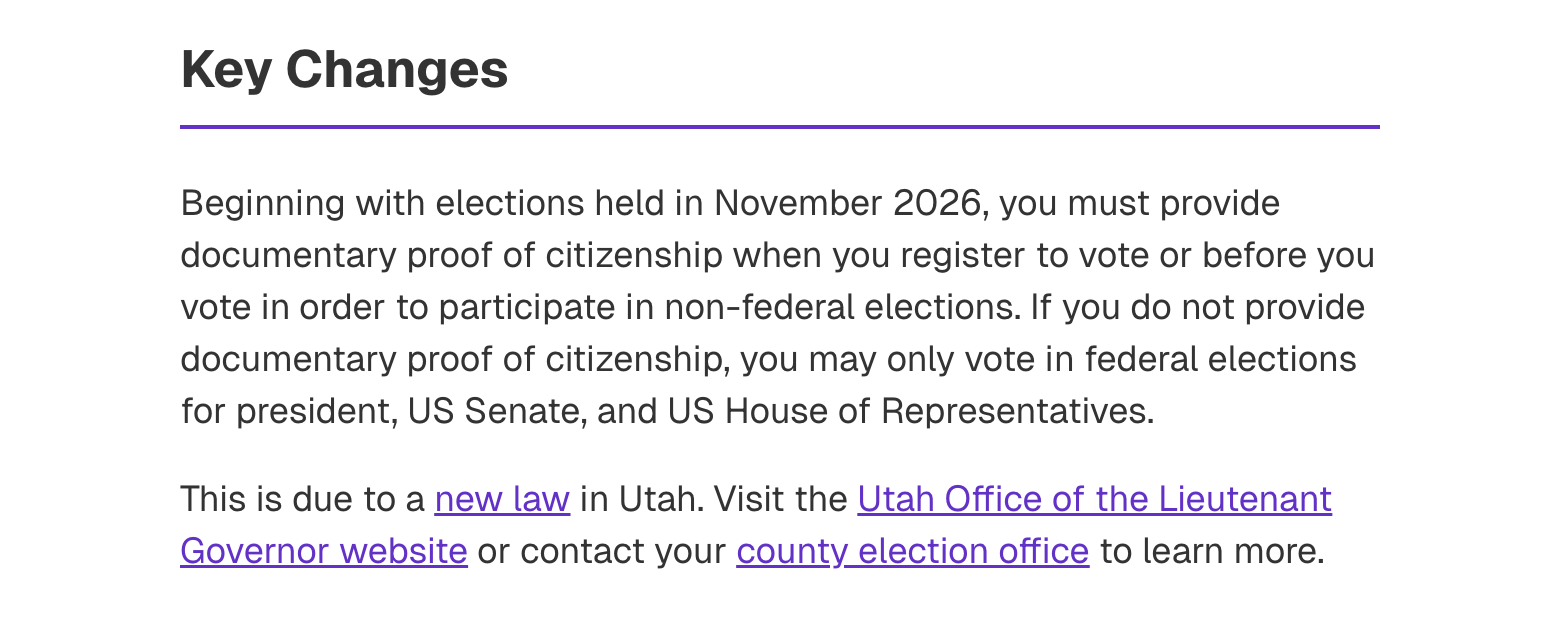
A Key Change for the 2026 Utah General Election.
When changes affect a significant number of voters and have a time-sensitive impact on someone’s ability to cast a ballot, we communicate them as an Urgent Election Notice. Our “You Should Know” information is also action-forward and timely, but may not be relevant to every voter.
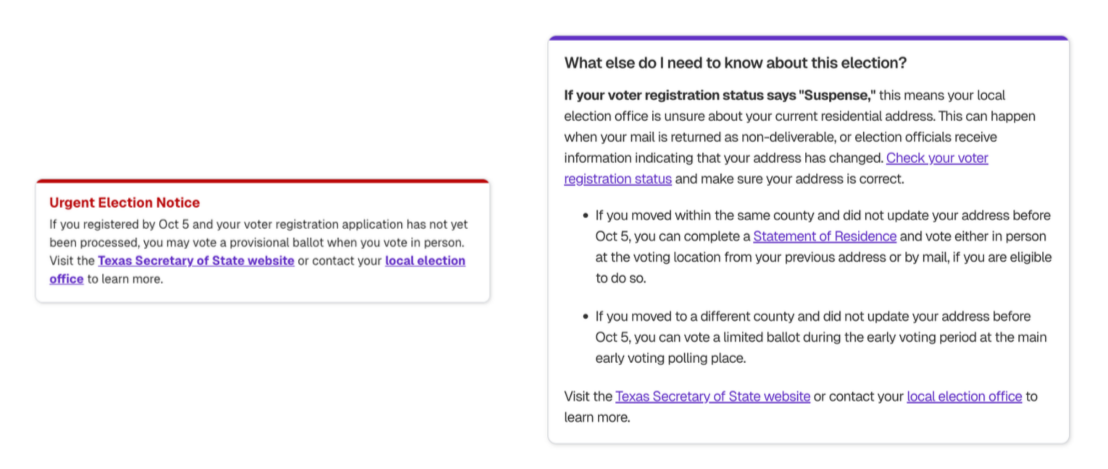
An Urgent Election Notice and “You Should Know” information for the 2026 Texas General Election.
We don’t want our Election Guides to read like a breaking news feed. When something is generating headlines but doesn’t change what a voter needs to do, the current guidance stays in place.
Behind the Scenes of an Urgent Election Notice
Publishing an Urgent Election Notice is a team effort. When updates happen, we move quickly to verify and distribute up-to-date guidance. Every situation is a little different, but the process generally looks like this:
- Through news reports or tracking tools, our Government Affairs team is alerted to a court ruling or other administrative action that urgently impacts voters. Together, Government Affairs and Research use authoritative sources to confirm the scope of the developments and their effect, and share the update internally.
- Government Affairs collaborates with the Communications team to draft the Urgent Election Notice, ensuring that the language is approachable, actionable, and accurate.
- Once drafted, the Urgent Election Notice undergoes two rounds of quality assurance by the Research team. Thorough verification is key to how we communicate trusted information.
- The finalized text is translated into Spanish.
- The Urgent Election Notice is published on the relevant Election Guide.
The layers built into this process guarantee accuracy, clarity, and efficiency. After the Urgent Election Notice is published, Government Affairs continues to check for updates, and modifications—including removal of the notice—are made, as necessary.
Monitoring the Final Stretch
Through Election Day, our team will continue monitoring developments so that Americans can focus on making their plan to vote. Election officials across the country are experts at running elections and adapting to change, and we’ve got their back.
Elections can be unpredictable, but Democracy Works helps ensure that unexpected changes aren’t a barrier to participation. With less than two weeks until November 3, we’ve reached a critical time to connect voters with trusted information. Voter confidence is built through successful encounters with the voting process.
By supporting our work, you can help keep voters informed about elections in their community. As changes happen, accurate election information is how we’re empowering voters to participate with confidence.