Ahead of the November 3 elections, Democracy Works is committed to building voter confidence. Through our tools and partnerships, we’re ensuring voters have the information they need to understand the process and make a plan to vote. Today, we’re explaining how ballots are counted and why voters can be confident that election results are accurate.
When voters cast their ballots in next month’s midterm elections, they can have confidence that their votes will be counted correctly. Across the country, election officials work hard to ensure that our elections are secure, accessible, and fair.
Counting all valid votes—and doing so accurately—is the cornerstone of election integrity, and extensive safeguards guarantee that election officials get it right. There is no credible evidence to support false claims that voting machines are vulnerable to foreign tampering or that illegal voting by noncitizens is widespread.
So how are ballots actually counted? The process may look different depending on the state and locality, but all states implement security measures to verify equipment, accurately tabulate the results, and confirm the outcome. Through our tools and partnerships, Democracy Works is helping voters understand these procedures to reinforce trust in the voting process.
Before the Election
In every state, election security starts before any votes are cast. State and local election officials conduct pre-election testing, such as logic and accuracy testing (L&A testing), to ensure that ballot counting machines return accurate results.
L&A testing confirms that ballot counting devices perform as expected and without errors. This can involve feeding test ballots through tabulators to simulate ballot tabulation, comparing the results with expected outcomes, and addressing technical or equipment issues. This functions as a “test run” before any real votes are cast.
Additionally, a majority of states adhere at least in part to optional federal standards for testing and certification of voting systems. The US Election Assistance Commission sets voluntary guidelines for the functionality, accessibility, and security of voting equipment. Other states have implemented their own testing and certification standards.
On Election Day
States use several voting technologies for voters to mark ballots and for election officials to count the results. Election jurisdictions within states may use different voting systems.
The overwhelming majority of votes are cast with a paper trail, enabling voters to review their selections on paper before their ballot is tabulated. Voters commonly hand-mark their ballot directly on paper or use an electronic ballot marking device, which prints a copy of the voter’s completed ballot. Typically, these paper ballots are then fed into optical scanners to tabulate the votes. Some small jurisdictions count paper ballots by hand, but this can be less accurate.
Alternatively, some jurisdictions use “direct-recording” electronic systems that store votes on a computer’s memory, with or without a paper trail. These systems have become less common, but can improve accessibility for voters with disabilities.
After votes are tabulated, the unofficial results are securely aggregated and reported. Unofficial results are uploaded online for the public to view, but ballot-marking and counting machines themselves are never connected to the internet.
Counting Mail Ballots
Election officials count mail ballots according to different procedures, depending on the state and election jurisdiction. Before mail ballots are tabulated, election officials use various methods to process them and verify they are eligible to be counted. Most states allow officials to begin processing mail ballots before Election Day, but results are never released before polls close. Like other paper ballots, mail ballots are typically tabulated by optical scanners, and the results may be reported separately or combined with the in-person count.
After the Election
After polls close, election officials conduct various checks to confirm the accuracy of the unofficial count reported on election night and finalize the official results. This process may stretch several weeks after Election Day, but that is not a sign that something is awry with the results.
Canvass
Official election results are determined through a process called canvassing.
During the canvass, state and local election officials review and reconcile every ballot cast, including ballots submitted in person on Election Day, ballots returned during early voting, provisional ballots, mail ballots, and ballots from uniformed and overseas citizens. Officials also review documentation completed by poll workers to confirm all voting procedures were followed correctly during the election.
This process ensures that every valid vote is counted. Local and state canvass deadlines are typically prescribed by state law.
Recounts
When election results are particularly close, election officials may conduct a recount to confirm that the ballots were counted correctly. Processes for triggering a recount and re-tabulating the results vary by state. Recounts are sometimes triggered automatically when the margin is close, or they may be requested by a candidate or another actor defined by law.
Certification
Certification is the final step to confirm the official results and declare a winner in each election. Once the canvass is complete, local and state officials issue a statement indicating that every vote has been counted correctly and the final election results are accurate.
Certification is a mandatory administrative process rather than a forum to contest the results.
Ensuring That Voters Understand and Trust the Process
Election integrity is essential to the democratic process. For voters to believe their voice matters, they have to understand how their vote is counted and why elections are secure. In every state, election officials take the necessary measures to count all legal votes carefully and accurately.
This year, Democracy Works expanded our guidance about election integrity issues. This data, distributed through TurboVote and our Elections API, equips voters with easy-to-understand information about how elections work in their state. Understanding the process before, during, and after Election Day is key to building confidence in outcomes and combatting false election claims.
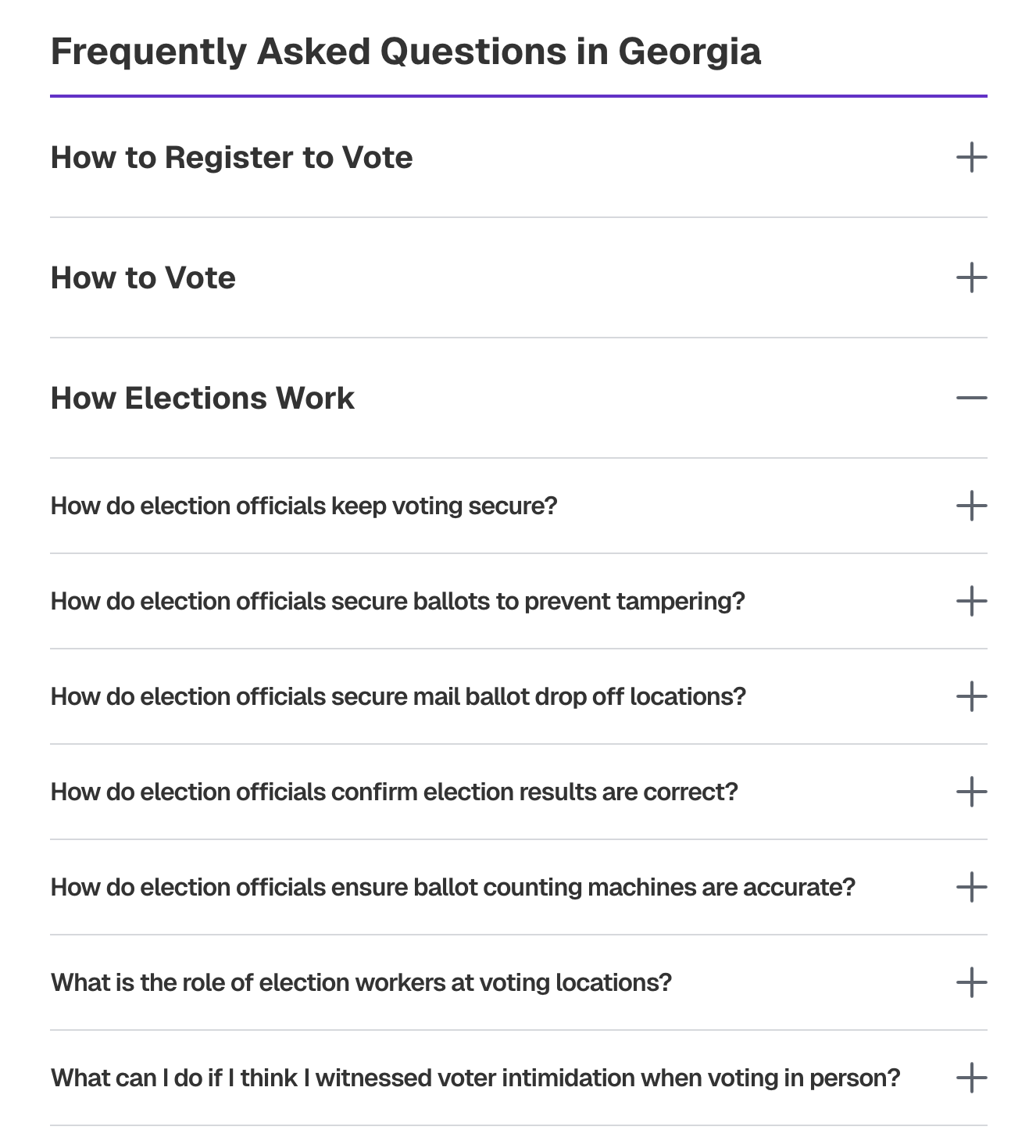
A TurboVote Election Guide for the 2026 Georgia General Election.
By supporting our work, you can help voters understand how elections are administered, secured, and confirmed. Amid election uncertainty, voter confidence is built on trust.